Class 10 Science can feel difficult for a simple reason: there is a lot to study, but having more study material does not automatically mean better preparation.
Many students buy several reference books, collect notes from different websites, download PDFs and save hundreds of questions. After a few weeks, they have plenty of material but still don’t know what they should actually solve.
The better approach is different.
First, understand the concepts and complete your NCERT textbook properly. Then use additional resources for practice, especially when you want to work on different types of questions and become comfortable with the kind of thinking required in the board examination.
One of the books students may come across while looking for additional Class 10 Science practice is the Educart CBSE Class 10 Science Question Bank 2026–27.
But is it actually useful?
And more importantly, does every Class 10 student need it?
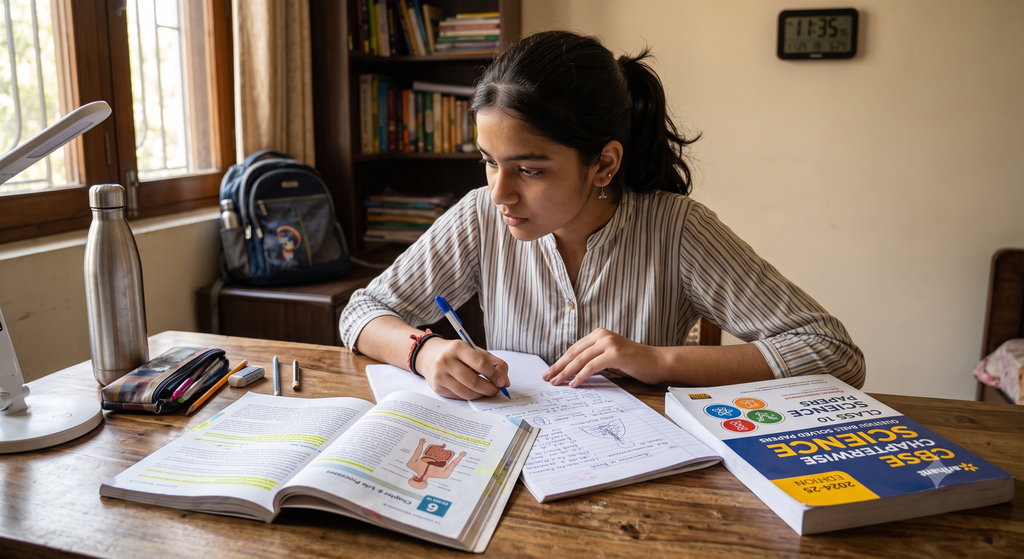
Do You Really Need a Reference Book for Class 10 Science?
Not necessarily.
Your first priority should be the NCERT textbook. Before spending money on a question bank, make sure you have actually read the chapters, understood the concepts and solved the questions provided in your textbook.
An additional book becomes useful when you need more practice.
For example, you may understand a chapter but still struggle when the question is presented in an unfamiliar way. This is where a good question bank can help.
It can give you opportunities to practise:
- Different question formats
- Application-based questions
- Competency-based questions
- Case-based questions
- Previous-year-style questions
- Chapter-wise practice
- Revision questions
So the question is not:
“Which book will replace NCERT?”
A better question is:
“Which resource can I use after NCERT to improve my practice?”
What Should You Look for in a Class 10 Science Question Bank?
Before buying any book, don’t just look at the number of questions.
A book with thousands of questions isn’t automatically useful.
Instead, look for the following.

1. Chapter-Wise Organisation
A chapter-wise structure makes it easier to practise immediately after completing a chapter.
For example, after finishing “Chemical Reactions and Equations”, you should be able to practise questions specifically related to that chapter instead of searching through a large collection of mixed questions.
This also makes revision easier before school tests and examinations.
2. Different Types of Questions
Board preparation shouldn’t be limited to memorising direct questions.
A useful practice resource should expose you to different formats so that you become comfortable when the wording of a question changes.
This is particularly important for students who know the theory but become confused when they see an unfamiliar question.
3. Competency-Based Questions
Competency-based questions require you to use what you have learned rather than simply reproduce a definition.
For example, instead of asking only for the definition of oxidation, a question may provide a situation or reaction and ask you to identify what is happening.
Practising these questions can help develop application skills.
4. Case-Based Questions
Case-based questions present information, an experiment, a situation or a passage and then ask several questions based on it.
Practising this format beforehand can make the actual examination feel less unfamiliar.
5. Explanations and Solutions
A question bank is much more useful when you can understand why an answer is correct.
Don’t judge a book only by the number of questions it contains.
The quality of the solutions matters too.
NCERT vs Question Bank: Which Should You Study First?
This is where many students make a mistake.
They start solving hundreds of questions from a reference book without properly understanding NCERT.
I wouldn’t recommend that.
A more sensible order is:
NCERT → Understand the chapter → Solve NCERT questions → Additional practice → Revise mistakes → Sample papers
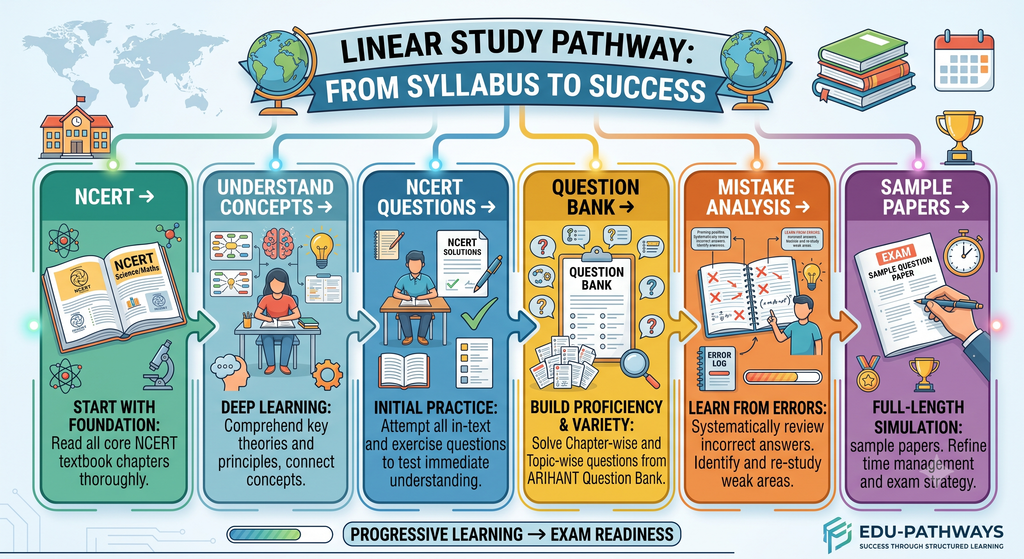
For example:
Step 1: Read the NCERT chapter
Don’t just read it once.
Understand the concepts, diagrams, activities, equations and important examples.
Step 2: Make sure you can explain the concepts
If you cannot explain a concept in your own words, solving more questions may not fix the underlying problem.
Step 3: Solve NCERT questions
Try them without looking at the answer first.
Step 4: Use a question bank for additional practice
Now you can test whether you can apply the concepts to different questions.
Step 5: Maintain a mistake list
This is one of the most underrated preparation techniques.
Whenever you get a question wrong, write down:
- What did I misunderstand?
- Was it a concept mistake?
- Did I forget a formula or equation?
- Did I misread the question?
- Was my answer incomplete?
Step 6: Attempt sample papers later
Once most of the syllabus is completed, start practising complete papers under a time limit.
Educart CBSE Class 10 Science Question Bank 2026–27: What Does It Offer?

The Educart Class 10 Science Question Bank 2026–27 is designed as an additional practice resource rather than a replacement for NCERT.
The current product information highlights chapter-wise practice along with NCERT-based questions, previous-year questions and competency-based questions. The listing also describes additional exam-oriented material such as case-based practice and revision resources.
That combination is potentially useful because students often need more practice after finishing the textbook.
However, there is an important distinction:
A question bank can provide practice. It cannot replace understanding.
If you haven’t studied the chapter properly, simply solving more questions won’t magically make the topic easier.
What I Like About the Idea of Using a Question Bank
The biggest advantage of a structured question bank is convenience.
Instead of collecting questions from five different places, you can have a reasonably organised source for additional practice.
For a Class 10 student, this can be useful because you can follow a simple routine:
Finish chapter → practise questions → check mistakes → revise → move ahead.
Another advantage is exposure to different question formats.
A student may be comfortable with straightforward questions but struggle when the same concept appears in a case-based or competency-based format.
Regular practice can reduce that problem.
But Is Educart Necessary for Every Student?
No.
And this is probably the most important part of this review.
You do not need to buy Educart simply because someone else is using it.
If you already have:
- NCERT
- Good class notes
- School worksheets
- Previous-year questions
- Enough practice material
- Sample papers
then buying another question bank may not make a huge difference.
In that situation, your time may be better spent actually solving what you already have.
A ₹500–₹700 book that remains unused is less valuable than a free resource that you practise consistently.
The value of a question bank depends heavily on how you use it.
Who Should Consider Buying It?
I would consider a question bank like this more useful for students who:
- Want structured chapter-wise practice
- Have completed or are regularly studying NCERT
- Need additional questions after classroom work
- Want exposure to different question formats
- Find it difficult to organise practice material themselves
- Want an additional exam-oriented resource
Who May Not Need It?
You may not need it if:
- You haven’t properly completed NCERT.
- You already have enough quality practice material.
- You rarely solve the books you already own.
- You’re buying it only because your friends have it.
- You’re expecting one book to guarantee a high percentage.
That last point is especially important.
No question bank can guarantee 90%, 95% or 100%.
Your result will depend on your understanding, consistency, revision, question-solving ability and performance in the actual examination.
How I Would Use the Educart Question Bank Alongside NCERT
If you decide to use it, I wouldn’t try to finish the entire book as quickly as possible.
Instead, use it strategically.
During the First Reading of a Chapter
Focus mainly on NCERT.
Understand the concepts before worrying about completing large numbers of additional questions.
After Completing the Chapter
Move to additional practice.
Start with questions that test whether you actually understood the chapter.
During Revision
Focus more on questions you previously got wrong.
There is little benefit in repeatedly solving questions that you can already answer easily.
Before School or Mid-Term Exams
Use the chapter-wise sections to revise the topics included in your examination.
Before Boards
Shift towards mixed practice, competency-based questions, case-based questions and full-length sample papers.
This gradually changes your preparation from “I know the chapter” to “I can answer questions from the chapter.”
Should You Buy One Book for Every Subject?
Again, not necessarily.
Some students think that scoring well requires buying separate reference books for every subject.
That’s not always true.
Instead of asking:
“How many books should I buy?”
ask:
“How much quality practice am I getting from the books I already have?”
One properly used book can be more useful than five books that are barely opened.
If you decide to purchase additional resources, choose them according to your actual weakness.
For example:
- Weak concepts → strengthen NCERT and classroom learning first.
- Weak question-solving → use a question bank.
- Weak time management → practise sample papers.
- Weak revision → use concise revision material.
- Repeated mistakes → analyse your mistakes instead of simply solving more questions.
Question Bank vs Sample Papers: Which Is Better?
They serve different purposes.
| Resource | Main purpose |
|---|---|
| NCERT | Concept understanding and core syllabus |
| Question Bank | Chapter-wise and varied practice |
| Previous-Year Questions | Familiarity with past exam questions |
| Sample Papers | Full-paper practice and time management |
| Notes | Quick revision |
| Mistake Notebook | Personal revision of weak areas |
You don’t necessarily have to choose only one.
The important thing is when you use each resource.
A question bank is generally more useful while working through individual chapters.
Sample papers become increasingly useful when you are ready to practise the complete examination format.
How Many Questions Should You Solve Every Day?
There is no magic number.
Don’t decide:
“I have to solve 100 questions every day.”
Instead, set a quality target.
For example, you might solve 20–30 questions carefully and spend time understanding your mistakes.
That can be more productive than rushing through 100 questions and checking only whether your final answers match.
Your goal isn’t to finish pages.
Your goal is to improve your ability to answer questions.
What About Students Who Are Targeting 90%+?
If you’re targeting a high score, don’t focus only on difficult questions.
A strong preparation strategy should include three levels:
Level 1: Basic Understanding
Can you explain the concept?
Level 2: Standard Questions
Can you apply the concept to normal examination questions?
Level 3: Application
Can you handle unfamiliar, competency-based or case-based questions?
You need all three.
Trying to solve extremely difficult questions while your basic concepts are weak isn’t an efficient strategy.
My Honest Take on the Educart Class 10 Science Question Bank
I wouldn’t call it a compulsory book.
NCERT remains the starting point, and students should not feel that they need to purchase an expensive collection of reference books to score well.
However, if you are looking for a structured additional practice resource and you prefer having chapter-wise questions and different exam-oriented formats collected together, the Educart question bank is worth considering.
Its usefulness will depend much more on your study habits than on the brand name printed on the cover.
If you buy it but don’t solve the questions, it won’t help.
If you use it consistently after studying NCERT, analyse your mistakes and gradually improve your weak areas, it can become a useful part of your preparation.
Where Can You Check the Book?
If you think the book fits your preparation style, check the current edition, seller, price and availability before purchasing.
Keep in mind that online prices and availability can change, so it’s better to check the current listing rather than relying on an old price mentioned in a blog post.
Frequently Asked Questions
Is NCERT enough for Class 10 Science?
NCERT should be your primary resource. However, some students benefit from additional practice, especially for different question formats and examination-oriented practice.
Should I solve a question bank before NCERT?
I wouldn’t recommend making a question bank your first priority. Understand the NCERT chapter first and then use additional questions to test and strengthen your understanding.
Is a question bank necessary for scoring 90%+?
No. A question bank is a resource, not a requirement. Students can score very well without a particular reference book if they have strong concepts, consistent practice and effective revision.
Is Educart useful for Class 10 Science?
It can be useful as an additional practice resource, particularly for students who want structured chapter-wise practice and exposure to different types of questions.
Should I buy multiple reference books?
Usually, there is no need to collect many books. One good additional resource that you actually use is generally more useful than several books that remain unfinished.
When should I start solving a question bank?
You can start chapter-wise practice after understanding the corresponding NCERT chapter. Don’t wait until the final weeks before the board examination to begin all your practice.
Should I solve sample papers or a question bank first?
For most students, chapter-wise question-bank practice should come first. Once you have covered enough of the syllabus, move towards full-length sample papers to practise time management and the complete paper format.
Can a question bank guarantee good marks?
No. No book can guarantee a particular percentage. Your marks depend on your preparation, understanding, practice, revision and performance in the examination.
Final Verdict
Don’t buy a Class 10 Science book because someone tells you that it is the “secret” to scoring 95% or 100%.
Start with NCERT.
Understand the concepts.
Solve the textbook questions.
Then identify what you’re missing.
If you need more chapter-wise practice and want a structured collection of different question formats, an additional question bank such as the Educart Class 10 Science Question Bank 2026–27 can be a useful option.
But remember the most important rule:
A book doesn’t improve your marks. The way you use the book does.
So instead of trying to collect every resource available, choose a manageable set of materials and actually complete them.
That approach will usually take you much further than having a shelf full of unfinished books.